Genuine Soundware Compact DeLuxe v1.0.0 晶体管风琴
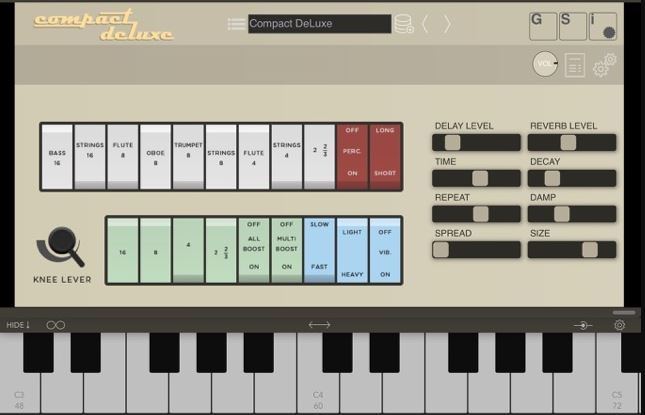
在众多晶体管风琴中,Farfisa Compact DeLuxe 和它的兄弟 Compact Duo 至少在七十年代早期和中期的欧洲节拍音乐界是最常用的风琴之一。
这种风琴的电子电路相对简单,至少在理论上是如此:晶体管风琴没有使用像音轮模型(Hammond 和 Pari)那样的机械音调发生器,而是使用了一种名为”高八度合成器”(简称 TOS)的电路,负责生成 12 种波形,每个波形对应风琴键盘上最后一个八度的每个音符。基本波形通常介于斜坡和三角波之间。较低的八度音程是通过”分频器”电路产生的,该电路可以将每个波形的频率减半,以此类推,直到每个较低的八度音程,直至踏板音。在每个音级上,谐波含量都有所减少和增加。
结果是,不同八度的相同音符的振荡器完全同步,因此所有 C 音符、所有 C# 音符、所有 D 音符等等都同步。同样的技术也用于模拟管弦乐声音(小提琴、小号等)的所谓”弦乐器”或”弦键盘”——参见 GSi 的 Electrorchestra。组合风琴中的各个音域是通过将原始波形通过滤波器组产生的,因此有些波形经过低通滤波以获得类似低音的声音,有些波形经过高通滤波以获得类似小提琴的声音等等,有些波形还会经过多个滤波器。这也会在不同音域的波形之间增加一定程度的相移,这就是为什么例如长笛 8′ 和小提琴 8′ 之间的和并非两个波形的完全叠加,而是略有不同的原因。这正是那些被低估的细节之一,它让一些组合风琴的音色变得独一无二。
GSi Compact DeLuxe 的音色引擎也包含在 GSi Gemini 和 Crumar Mojo 61 中。
当然,这类乐器如果搭配外部效果器和音箱使用,效果会更好。不妨看看 GSi 的产品目录,并尝试一下 GSi 提供的一些效果器。
主要特点组件建模引擎(无采样,全实时合成)全复音(61 个音符,12 个高八度振荡器 + 分频器)按键多触点模拟,具有真实且可调节的按键点击效果真实还原 Farfisa 寄存器滤波器还原背景噪音和漏音可调节颤音(速度和深度)内置立体声延迟效果内置立体声混响效果内置编程器,提供无限程序内置用户手册可作为独立应用程序和音频插件使用极低的 CPU 和 RAM 占用率
Among the many transistor organs of the past, also known as “Combo Organs” (mostly because some of them also had a rhythm section and built-in speakers), the Farfisa Compact DeLuxe, along with its big brother the Compact Duo, was one of the most used organs at least in the european beat scene of the early and mid seventies.
The electronic circuit of this kind of organ is relatively simple, at least on paper: rather than using a mechanical tone generator like the tonewheel models (Hammond and Pari), the transistor organs used a circuit called “Top Octave Synthesizer”, TOS for short, responsible of the generation of 12 waveforms, one for each note of the last octave of the organ keyboard. The basic waveform was usually something halfway between a ramp and a triangular. The lower octaves were produced by means of “divider” circuits that could halve the frequency of each waveform, going so forth for each lower octave down to the pedalboard tones. At each division, something was lost and something was gained in terms of harmonic content.
he result was that the same notes of different octaves had oscillators perfectly in sync, so all C notes were in sync, all C#, all D and so on. This same technique was also used in so-called “string machines” or “stringer keyboards” that emulated orchestral sounds (violins, trumpets, etc.) – see GSi’s Electrorchestra.The various registers in combo organs were produced by passing the raw waveforms through a filter bank, so some waveforms were low-pass filtered for bass-like sounds, some were high-pass filtered for violin-like sounds, etc. and some waveforms also went through more than one filter. This also adds some level of phase shifting between waveforms coming from different registers, the reason why the sum between, e.g. a Flute 8′ and a Violin 8′ isn’t exactly the superimposition of the two waveforms, but something slightly different. And this is one of those underrated details that made the sound of some Combo Organs pretty unique.
The sound engine of GSi Compact DeLuxe is also included in the GSi Gemini as well as in the Crumar Mojo 61.
Of course this type of instrument gives its best if run through external effects and amps. Have a look at the GSi catalog and experiment with some of the effects offered by GSi.
Main featuresComponent Modeling engine (no samples, all real-time synthesis)Full Polyphony (61 notes, 12 Top-Octave Oscillators + Frequency Dividers)Key multi-contact simulation with authentic and adjustable key clickAuthentic recreation of the Farfisa register filtersRecreation of the background noise and leakageAdjustable vibrato (speed and depth)Built-in Stereo Delay effectBuilt-in Stereo Reverb effectBuilt-in programmer with unlimited ProgramsEmbedded user’s manualAvailable as Stand-alone application and audio pluginVery low CPU and RAM usage
支持系统:Windows
文件大小:4MB
登录并开通会员即可下载此资源
登录 / 开通会员